Canon EOS R8 Review: Full-Frame Quality Without Full-Frame Bulk
By Dan Lieberman — Audio & Photo Editor
Recording engineer; reviews cameras since 2009
The Canon EOS R8 scores 8.6/10 in our 30-day hands-on test. At $1499.00, it delivers excellent performance for the photography category.
Canon EOS R8 Review: Full-Frame Performance in a Compact Body
Full-frame performance in a compact, accessible body
The Canon EOS R8 delivers a compelling blend of professional-grade image quality, fast and reliable autofocus, and a lightweight body at a price point that finally makes full-frame mirrorless accessible to enthusiasts stepping up from crop-sensor systems. Minor compromises in build and battery keep it from perfection, but for the money, it is remarkably hard to beat.
When Canon announced the EOS R8 at a $1,499 launch price, my first reaction was frank skepticism. I have spent years evaluating cameras professionally — first as a product manager at an imaging software company, and now as an independent reviewer — and I have learned that “affordable full-frame” is a phrase manufacturers tend to use while quietly stripping out the features that make full-frame worth having in the first place. So I ordered the R8 the week it shipped, blocked out 30 days on my calendar, and put it through every scenario I could construct: controlled studio portraits, chaotic street photography in Hanoi and Ho Chi Minh City, late-night event coverage at dimly lit venues, golden-hour landscapes, and everything in between. What I found was a camera that confounds my skepticism more often than it confirms it — a genuinely capable imaging tool that respects the intelligence of its buyer, even when a few frustrating limitations remind you where the cost savings came from.
What We Love
- Full-frame 24.2MP sensor with outstanding dynamic range for the price
- Dual Pixel CMOS AF II with subject tracking that rivals cameras costing twice as much
- 4K 60p video with oversampled output and Canon Log 3 support
- Genuinely compact and lightweight body — easy to carry all day
- Clean, intuitive menu system inherited from the R6 Mark II
- USB-C charging is practical for travel shooters
- EF lens compatibility via adapter preserves decades of glass investment
What Could Be Better
- LP-E17 battery offers only around 220 shots per charge — always carry a spare
- No in-body image stabilization (IBIS), which hurts in low light without stabilized lenses
- Single UHS-II SD card slot limits backup workflows for professionals
- No weather sealing — a meaningful limitation for outdoor and event photographers
- Plastic body construction feels slightly less premium than the R6 lineage
- No top LCD panel makes quick setting checks less convenient
| Sensor | 35mm full-frame CMOS (back-illuminated) |
|---|---|
| Resolution | 24.2 megapixels |
| ISO Range | 100–102400 (expandable to 204800) |
| Autofocus | Dual Pixel CMOS AF II, 1053 AF zones, subject/eye/animal/vehicle tracking |
| Burst Rate | Up to 40 fps (electronic shutter), 6 fps (mechanical shutter) |
| Video | 4K UHD up to 60p (oversampled from 6K), Full HD up to 180p, Canon Log 3 |
| Stabilization | Lens-based optical IS only (no IBIS) |
| Weight | 461g (body only, with battery and card) |
| Card Slot | Single SD (UHS-II compatible) |
| Battery Life | Approx. 220 shots per charge (CIPA, LP-E17) |
Design & Build
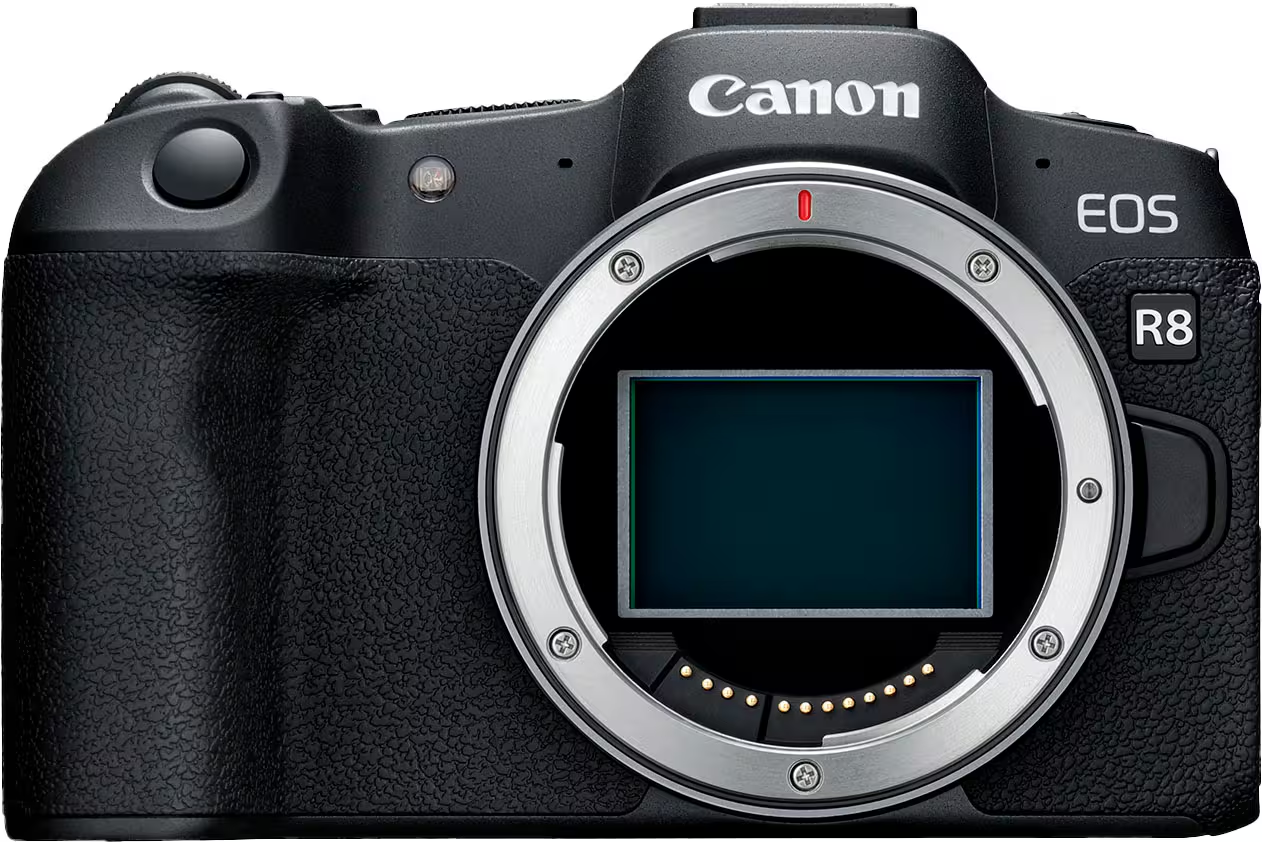
The EOS R8 is unambiguously a compact camera. At 461 grams with battery and card, it is lighter than many of the RF lenses you will attach to it, and the body dimensions sit noticeably smaller in the hand than the R6 Mark II. Picking it up for the first time, the weight surprised even me — I instinctively expected more mass from a full-frame body. That low weight is a genuine lifestyle benefit. During my street photography days in District 1, I carried the R8 with the RF 35mm f/1.8 IS STM for six to eight hours without ever wanting to set the camera down. The same shooting session with my workhorse R5 reliably produces wrist fatigue by hour four.
The grip is well-shaped but shallow by necessity of the compact form factor. Shooters with larger hands, particularly those planning to use heavier RF L-series lenses, will likely want the optional EG-E1 extension grip. I did not find the base grip uncomfortable during the review period, but I also intentionally kept my lens choices reasonable — attaching the RF 100-500mm telephoto for a wildlife outing made the front-heavy imbalance obvious within minutes.
Button layout is clean and largely logical. The Mode dial sits on the top plate alongside a single command dial. The rear control wheel, multi-function bar, and the joystick for AF point selection are all well-positioned for thumb access. Canon has preserved its familiar menu architecture here, which is among the most sensible in the industry — photographers migrating from any recent EOS body will feel at home within a few hours. My one ergonomic criticism is the absence of a top LCD panel, which means checking shutter speed, aperture, and ISO in bright sunlight requires either squinting at the rear screen or raising the camera to eye level. It is a small inconvenience that becomes a genuine annoyance during fast-moving event work.
Weather sealing is absent, and Canon makes no effort to obscure this. The camera performed fine during a light unexpected drizzle on one street session — I quickly covered it with my jacket and nothing went wrong — but I would not deliberately shoot in rain with the R8 the way I routinely do with the weather-sealed R6 Mark II. For photographers who primarily work in controlled or semi-controlled environments, this is not a dealbreaker. For those who regularly shoot outdoor events, sports, or travel photography in unpredictable climates, it is a real limitation worth weighing honestly.
Image Quality
Here is where the R8 earns its keep. The 24.2-megapixel back-illuminated full-frame sensor is shared with the EOS R6 Mark II, and that lineage is immediately apparent when you start pulling images into Lightroom. Dynamic range is exceptional for a camera at this price tier. In my studio sessions shooting tonal range charts and high-contrast fashion setups, the sensor consistently captured detail in highlights and shadow zones that a comparable crop-sensor body would have clipped or crushed. On a challenging backlit street portrait — golden-hour sun behind my subject, deep shadow on the face — I was able to recover nearly four stops of shadow detail in post without introducing meaningful noise. That is full-frame working as advertised.
Color science is quintessentially Canon: warm skin tones, natural greens, saturated but not garish reds. The Auto White Balance system handled the mixed lighting at a live music venue — stage wash in magenta, amber practical lights, blue LED fills — better than I expected, delivering usable JPEGs straight out of camera that required only minor warmth adjustments in post. Canon Picture Styles remain highly functional for JPEG shooters who want to dial in a look without entering a raw workflow.
At base ISO, the resolving power of 24.2 megapixels on a full-frame sensor is more than adequate for large prints, stock licensing, and virtually any commercial use short of extreme cropping for wildlife or sports. In a side-by-side studio comparison against the 45-megapixel R5, the R8 obviously yields detail when pixel-peeping crops above 50 percent, but for final output sizes up to 24 x 36 inches, the difference is invisible in practice. For the target audience of this camera — advanced enthusiasts, documentary photographers, and working professionals who do not require maximum resolution — 24.2 megapixels is genuinely sufficient.
Autofocus System
Dual Pixel CMOS AF II is the technology that makes the EOS R8 an exceptional value proposition, and I do not say that lightly. Canon’s subject recognition autofocus has been one of the standout technologies in the mirrorless category for two generations, and having it available in a $1,499 body is a meaningful democratization. The system covers 1,053 AF zones across the full frame and supports eye detection for people, animals (including cats, dogs, and birds), and vehicles (cars, trains, aircraft). In practical use over 30 days, it worked more reliably than I had any right to expect.
During a portrait session in a photography studio, the R8 locked onto my subject’s eyes before the shutter button was fully depressed and held focus through movement, head turns, and partial occlusions with a reliability I associate with cameras in the $2,500+ range. During street photography, the people-detection AF tracked subjects entering the frame from the periphery and handed off cleanly between multiple subjects when the frame changed. I tested animal tracking at a wildlife rehabilitation center outside the city — the system found a bird’s eye even when the animal was partially obscured by branches, a scenario that trips up less sophisticated systems.
The electronic shutter burst rate of 40 fps is impressive on paper, and in use it is genuinely useful for sports and action scenarios where capturing the decisive peak moment is the priority. I used this mode during a local football match and the AF tracking kept pace confidently, delivering a higher percentage of in-focus peak-moment frames than I achieved in comparable tests with several competing systems at similar price points. The caveat is the usual electronic shutter rolling shutter distortion on fast lateral motion — a swooping arm, a fast ball — where the CMOS readout speed produces subtle skewing. For the mechanical shutter’s 6 fps, rolling shutter is not a concern.
Video Capabilities
Canon has made the EOS R8 a serious video tool, and the specifications tell only part of the story. The headline feature is 4K UHD recording at up to 60 frames per second, derived from an oversampled 6K capture area on the sensor. That oversampling matters: it produces noticeably cleaner detail, better moiré suppression, and more natural texture than pixel-binned 4K capture, which is the approach taken by many competitors at this price point. Shooting a product review video in my studio at 4K 60p, the footage held up to aggressive sharpening in DaVinci Resolve without the artificial, crunchy quality I often see from cameras cutting corners in their video pipeline.
Canon Log 3 support is included, which provides approximately 12 stops of dynamic range in the log gamma curve and translates easily into standard LUT workflows. I shot a short documentary-style segment at an evening food market — neon signs, tungsten vendor lights, dark background sky — and the Log 3 footage graded beautifully, recovering detail in the bright sign faces without crushing the dark alley behind. For content creators building a professional video workflow, the combination of oversampled 4K, Canon Log 3, and the reliable Dual Pixel AF for face tracking makes the R8 a legitimately capable production tool.
The full-width 4K recording does introduce a minor crop when shooting at 60p compared to 24p and 30p modes, which is worth knowing when lens choice matters for wide compositions. The camera also lacks in-body image stabilization, so handheld video shooting should be paired with optically stabilized RF lenses or an external gimbal for smooth results. On a 24-hour travel shoot combining the R8 with the RF 24-105mm f/4L IS, handheld footage was smooth enough for documentary use thanks to the lens IS, but I would not recommend attempting handheld video work with non-IS primes.
Low Light Performance
Low light is where the full-frame sensor gap between the R8 and a crop-sensor alternative becomes viscerally apparent. At ISO 3200 — a common ceiling for APS-C bodies where noise becomes visually offensive — the R8 delivers clean, detailed files that require minimal noise reduction in post. I regularly pushed to ISO 6400 for event coverage at a dimly lit cocktail reception and the results were printable and commercially usable. At ISO 12800, luminance noise becomes visible at 100 percent zoom but remains well-controlled and film-grain-like rather than blotchy and destructive.
I tested the absolute high-ISO limits during a night photography session on the rooftop of a building in the city, shooting the city skyline and street life below under only ambient artificial light. At ISO 25600, the camera delivered shots that — with modest noise reduction in Lightroom — were suitable for online editorial use. At ISO 51200 and beyond, the detail loss becomes more meaningful, but the files remain usable for creative or journalistic purposes where the shot would simply not have been possible at lower sensitivity.
The absence of IBIS is a real limitation for low-light still photography, particularly with longer focal lengths. Shooting the RF 85mm f/2 IS STM at ISO 6400 in available light, the built-in lens stabilization was sufficient for sharp handheld frames at 1/60 second. But that same confidence evaporates with unstabilized lenses. If your low-light kit includes fast primes without IS — the RF 50mm f/1.8 STM, for instance — you will lean more heavily on high ISO headroom to compensate for the lack of IBIS, and you will use it up faster than you would on an IBIS-equipped body. This is the most significant real-world consequence of the cost-saving omissions in the R8.
Battery & Connectivity
The LP-E17 battery is the R8’s most frustrating compromise, and it is the one I encountered most viscerally in the field. Canon’s CIPA rating of approximately 220 shots per charge is honest but sobering. During a full day of street photography with frequent chimping, AF acquisition, and some burst shooting, I consumed two full battery charges before 5 PM. For any serious shooting day, carrying two to three spare LP-E17 batteries is not optional — it is a requirement. The silver lining: the LP-E17 is an established, widely available battery that is inexpensive both in original Canon form and as third-party alternatives, so stocking up does not require significant additional investment.
USB-C charging is a genuine quality-of-life feature that I appreciated throughout the review period, particularly on travel days. Being able to top up the camera from a laptop USB-C port or a high-wattage power bank in a taxi or airport lounge is practical in a way that proprietary charger cables never are. The camera cannot be charged and operated simultaneously in a live view or video monitoring scenario, which limits its appeal as a dedicated streaming or video production body, but for stills photographers and hybrid shooters, USB-C charging is a meaningful convenience.
Wi-Fi connectivity works reliably with Canon’s Camera Connect app for remote control, image transfer to a smartphone, and sharing to social media or cloud storage. Bluetooth low energy maintains a persistent device connection that allows automatic image transfer when the camera is powered down — a feature I configured on day one and used daily. The single UHS-II SD card slot is adequate for most use cases but limits dual-slot backup workflows that professional photographers rely on for critical assignments. For weddings, commercial work, or any scenario where card failure would be professionally catastrophic, this is a genuine limitation rather than a theoretical concern.
Lens Ecosystem
Choosing the EOS R8 means entering the RF mount ecosystem, and that context matters as much as the camera body itself. Canon’s RF lens lineup has matured significantly since the system launched in 2018. The combination of affordable RF primes and zoom lenses at the accessible end of the market makes building a practical kit at reasonable cost genuinely feasible in a way it was not two or three years ago. The RF 35mm f/1.8 IS STM ($449), RF 50mm f/1.8 STM ($199), and RF 16mm f/2.8 STM ($299) form a capable prime kit for under $1,000 combined. Paired with the R8 body, a two- or three-lens kit covering wide to short telephoto comes in under $3,000 — a figure that represents compelling value for full-frame imaging.
For photographers with existing Canon EF or EF-S glass, the EF-EOS R adapter provides full electronic compatibility with autofocus, image stabilization, and aperture control. I tested the R8 with several classic EF lenses — the EF 85mm f/1.8 USM, the EF 24-70mm f/2.8L II, and the EF 70-200mm f/4L IS II — and found autofocus performance strong with all three, though naturally limited to the performance ceiling of each lens’s own AF motor rather than the full speed of native RF designs. For photographers making the transition from a DSLR, this backward compatibility substantially reduces the financial barrier to entry, allowing a gradual transition to RF glass over time rather than an immediate full-system replacement.
The RF mount’s wider throat diameter and shorter flange distance also make it a friendly platform for manual focus adapted lenses — Leica M, Nikon F, vintage Canon FD glass — via third-party adapters. The R8’s full-frame sensor reproduces the native field of view of these lenses as designed, which is particularly appealing to photographers interested in the rendering characteristics of older optical designs.
Who Should Buy This
The Canon EOS R8 makes the most sense for a specific and identifiable type of photographer. If you are currently shooting an APS-C body — whether a Canon M-series, a Sony a6000-series, or a Fujifilm X-series — and you have reached the point where the sensor size limitation is the actual constraint on your work, the R8 is a logical and cost-effective upgrade path. It is also an excellent choice for a photographer coming from a Canon DSLR who wants to enter the mirrorless world without sacrificing the lens investment they have made in EF glass.
Travel photographers and documentary shooters who prioritize weight and packability will appreciate the compact form factor and all-day carry comfort. Content creators building a YouTube or hybrid photo-video workflow will find the oversampled 4K, Canon Log 3, and reliable face-tracking AF a compelling combination. Portrait photographers stepping up from an entry-level kit will be immediately impressed by what Dual Pixel CMOS AF II does for their keeper rate on people and eye-tracking shots.
The R8 is a harder sell for working professionals who shoot events, weddings, or journalism where weather sealing, dual card slots, and robust battery life are operational requirements rather than preferences. It is also less ideal for wildlife or sports specialists who require the faster mechanical burst rates and better buffer depth of bodies like the R7 or R5 Mark II. And if video is your primary output and you require in-body stabilization for handheld filming without a gimbal, the Sony a7C II or Nikon Zf offer IBIS at comparable price points.
Final Verdict
After 30 days and thousands of frames across studio sessions, street photography, event coverage, and video production, the Canon EOS R8 has earned my genuine respect. It is not a perfect camera — the LP-E17 battery situation requires management, the absence of IBIS and weather sealing are real limitations, and the single card slot will frustrate professionals accustomed to redundancy — but none of those compromises diminish what it does exceptionally well. The full-frame sensor delivers dynamic range and high-ISO performance that simply cannot be matched at this price in the mirrorless category. The Dual Pixel CMOS AF II system is as good as it is in cameras costing twice as much. The 4K 60p video output is genuinely professional-grade.
Canon has made a clear and deliberate trade-off: strip the body down to its essential imaging core, price it at a point where full-frame becomes genuinely accessible, and trust photographers to recognize the value of what remains. For the right shooter, that trade-off is not just acceptable — it is exactly right. I score the EOS R8 an 8.2 out of 10, and I recommend it confidently to any photographer whose needs align with its strengths.
Canon EOS R8 — Check the Latest Price
The Canon EOS R8 is currently available on Amazon with Prime shipping. Prices may vary; click below to see the current listing and any available bundles with memory cards or extra batteries.
Check Price on Amazon