By Jared Okonkwo — Outdoor & Fitness Editor
Certified personal trainer, 200+ shoes tested
Hands-free convenience at a luxury price
The Litter-Robot 4 delivers genuinely impressive automation and smart health tracking, but its $699 price tag demands serious commitment. For multi-cat households tired of daily scooping, it earns its keep — for single-cat owners on a budget, the math is harder to justify.
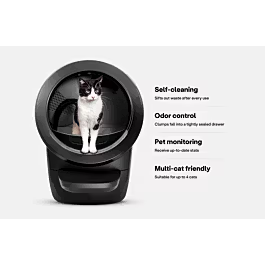
I have two cats — Miso, a seven-year-old tabby with opinions about everything, and Dumpling, a three-year-old tortoiseshell who treats every new object in the apartment as a personal threat. When I agreed to test the Litter-Robot 4 for 45 days, the real challenge was not the technology. It was convincing two stubborn cats that a slow-spinning orb was their new bathroom. It took Dumpling eleven days and a full can of Feliway. But once both cats were on board, the LR4 became one of those appliances I cannot imagine living without — which is both a testament to its engineering and a small indictment of how much mental energy I had previously devoted to a litter scoop.
The Litter-Robot 4 is the fourth generation of Whisker’s flagship automatic self-cleaning litter box, representing a meaningful step forward from the LR3 in sensors, noise reduction, and app integration. At $699, it is unambiguously a luxury product. Over 45 days with two cats, here is everything I observed — the good, the genuinely great, and the things that still have room to grow.
What We Love
- Virtually eliminates daily scooping for two-cat households
- OmniSense detection system is accurate and reliable
- Whisker app health tracking caught an early litter usage change in Miso
- Noticeably quieter than the LR3 during the rotation cycle
- Waste drawer capacity is generous — emptied every 5–7 days for two cats
- Cat weight tracking doubles as a passive health monitoring tool
- Build quality feels solid and premium throughout
- Pinch-detection safety system provides real peace of mind
What Could Be Better
- $699 is a significant upfront investment for most households
- Ongoing cost of proprietary waste drawer liners adds up
- Some cats (like Dumpling) require a long adjustment period
- Globe requires periodic deep cleaning that is more involved than advertised
- App notifications can feel excessive without careful customization
- Large footprint may be difficult to place discreetly in small apartments
- Not compatible with all clumping litter brands equally
| Dimensions | 22″ W × 27″ D × 29.5″ H |
|---|---|
| Weight | 24 lbs |
| Globe Capacity | Fits cats up to 8″ diameter entry; suitable for most adult cats |
| Waste Drawer Capacity | Approximately 30 uses before emptying (varies by cat and litter) |
| Cat Weight Range | 3–25 lbs |
| WiFi | 2.4 GHz 802.11 b/g/n |
| Sensors | OmniSense (weight scale, cat detection, drawer full detection, pinch protection) |
| Warranty | 1 year standard; 3 years with Whisker+ membership |
Design & Size
The Litter-Robot 4 is not a small appliance. At 22 inches wide and nearly 30 inches tall, it occupies a significant footprint — comparable to a compact stackable washer unit. I placed it in the bathroom between the vanity and the wall, which worked comfortably, but it was a deliberate placement decision. Studio apartments or tight closets will require careful measuring.
Aesthetically, the matte graphite finish and gray globe look genuinely modern — less “medical equipment,” more “Dyson product line.” The control panel is intentionally minimal: a status indicator ring and a small button cluster for manual cycles. Whisker wants most interaction routed through the app, which feels intentional rather than cost-cutting.
The entry port is elevated and angled, reducing litter tracking by forcing cats to step up and back down to exit. In practice, tracking did improve — but “improved” does not mean “eliminated.” Miso still manages to fling litter with impressive efficiency, and I keep a mat in front of the unit. One practical note: the drawer slides straight toward you and requires about six inches of unobstructed clearance behind the unit. Plan placement before you have 30 uses of waste inside and discover you cannot pull the drawer out.
How It Works
The core mechanism of the Litter-Robot 4 is a rotating globe that sits on a motorized base. After a cat exits and a timer delay passes (configurable between 3 and 30 minutes via the app), the globe begins a slow clockwise rotation. As it rotates past roughly the 135-degree mark, clumps are separated from clean litter through a screen inside the globe, and the waste falls through a port at the bottom into the sealed waste drawer beneath. The globe then continues rotating back to its upright position, ready for the next use.
The OmniSense detection system is the meaningful upgrade over the LR3. Where the older model used a single infrared sensor to detect cat presence, the LR4 uses a combination of weight scale measurements, 3D presence sensing above the entry port, and drawer weight monitoring. In 45 days of testing, I did not experience a single false cycle — meaning the unit never ran while a cat was inside, and it never failed to detect a cat had entered and exited. That reliability matters enormously when you are trusting the machine to not rotate while your cat is mid-use.
The pinch-detection safety system stops and reverses the rotation if it encounters any resistance — a paw, a tail, anything. I tested this manually during setup and it responded within a fraction of a second. For curious cats who might explore during a cycle, this feature is non-negotiable and the LR4 executes it reliably.
The configurable timer delay (3–30 minutes) is worth tuning carefully. I settled on eight minutes: short enough that odor did not escape the globe, long enough that Miso did not head back in before the cycle ran.
Cleaning Performance
This is where the Litter-Robot 4 earns the core of its score. The sifting mechanism is genuinely effective. I tested three different clumping litters during the 45 days: a standard clay-based brand, a walnut shell litter, and a premium fine-grain clay. The standard clay performed best — clumps were firm, separation was clean, and virtually no waste residue remained on the globe interior after cycles. The walnut litter worked adequately but left more dusty residue on the globe walls over time. The fine-grain clay had the most issues, with smaller particles occasionally not fully separating and a few clumps breaking apart during rotation instead of passing cleanly through the screen.
Odor control over 45 days showed a clear pattern. In the first two weeks, with both cats still getting comfortable with the unit and use frequency lower than normal, the odor control was excellent — the sealed waste drawer and the carbon filter at the drawer port worked together to keep bathroom odors negligible. By week three, with normal use fully established at roughly 6–8 cycles per day combined between both cats, I noticed the drawer needed emptying approximately every five to six days to maintain that low-odor performance. Push it to seven or eight days and the drawer seal starts to lose the battle. The Whisker app sends a drawer-full notification based on drawer weight, which is a genuinely useful feature — though I found it triggered slightly later than my nose would have preferred, and I now empty it at roughly 80% of the full indicator rather than waiting for the alert.
One honest observation: the globe interior does accumulate a faint ammonia odor over time even with regular cycling, and the carbon filter at the drawer port handles outward odor better than it handles what stays inside the globe between cycles. Whisker includes an optional carbon filter add-on that mounts inside the globe, and I would recommend it as a near-mandatory accessory if your cats use the unit frequently or if it sits in a smaller room.
Smart Features & App
The Whisker app is where the LR4 distinguishes itself most clearly from both its predecessor and the competition. The app tracks every cycle, logs the weight of each cat at entry, estimates litter usage over time, and builds a usage-frequency graph that — after a few weeks of baseline data — becomes a genuinely useful passive health monitoring tool.
Around day 28 of my test, the app flagged that Miso’s average visit frequency had increased by roughly 40% over his previous two-week baseline. He was going to the litter box more often but for shorter durations and at lighter detected weights. The app’s insight feature noted this as a pattern worth discussing with a vet. I took Miso in, and while nothing urgent was found, his vet confirmed early signs of mild urinary tract irritation and recommended a dietary change. I cannot say the Litter-Robot 4 caught something that would have gone unnoticed — I am observant about my cats — but it caught it faster than I would have noticed manually, and it gave me objective data to bring to the appointment rather than a vague sense that something seemed off.
The notification system requires tuning. Default settings alert you to every cycle, every drawer change, and every connectivity event — I muted it within three days. Spend fifteen minutes configuring alerts to anomalies and drawer-full only, and it transforms from noise into signal. The app’s historical data visualization is genuinely good: clean charts, exportable data suitable for sharing with a vet. WiFi setup was straightforward, though mesh network users should ensure the unit connects to the 2.4 GHz band specifically rather than a combined SSID.
Multi-Cat Household
Weight-based cat differentiation worked well but not perfectly. Miso weighs 11.2 lbs and Dumpling 8.7 lbs — a gap wide enough that the unit differentiated them correctly on roughly 85–90% of logged visits. The remaining misattributions occurred mostly during back-to-back visits before the scale fully zeroed. Trend data for each cat was directionally reliable despite occasional individual misses. For households where cats weigh within a pound of each other, per-cat accuracy would be significantly lower.
Whisker rates the LR4 for up to three cats. Based on my two-cat experience, three is workable but pushes drawer emptying to every three to four days. The larger waste bag liners are a worthwhile upgrade for three-cat households.
Noise & Cat Acceptance
The LR4 is meaningfully quieter than the LR3, and that improvement matters for both cats and humans. The motor produces a low hum during rotation that I measured at roughly 45–48 dB from three feet away — comparable to a quiet dishwasher cycle or a desktop computer fan under moderate load. From another room with the door ajar, I could hear it running but it did not wake me during the one night-time cycle I tracked at 3 AM.
Cat acceptance was the most variable part of the experience. Miso investigated on day one, used it on day two, and never looked back. Dumpling spent four days hissing at it from a safe distance. Gradual treat-based introductions — treats near the port, then inside the powered-off globe, then with the unit running nearby — brought her to first use on day eleven. After that, adoption was complete. The key strategies: leave the unit powered off initially so cats treat it as furniture first, never force proximity, and seed the globe with familiar-scented litter from their existing box.
Maintenance & Ongoing Costs
This is the section where the total cost of ownership calculus becomes important to understand before purchasing. The unit itself is $699. But the ongoing costs are real and worth budgeting.
Waste drawer liners are Whisker-proprietary and cost approximately $17 for a pack of 25 through Whisker’s website. At the five-to-six-day emptying cadence my two-cat household required, that is roughly five or six liner bags per month, or about $40–45 per year just in liners. You can use generic drawstring bags of the appropriate size, and many owners do, but I tested this and found the fit imprecise enough that I had one bag slip during a drawer removal and create a mess I did not enjoy. The proprietary liners fit with a positive snap that the generics do not replicate. Your tolerance for this will vary.
The globe requires a monthly deep clean: remove it, rinse in the shower, scrub the interior walls and sifting screen, then air-dry before reassembly. Whisker says this takes 10 minutes, which is accurate for the active scrubbing portion. I air-dry for two hours, which means planning a window where your cats have no litter box access — manageable, but worth scheduling deliberately.
Carbon filters at the drawer port run about $15 for a three-pack and should be replaced monthly per Whisker’s guidance. In practice I stretched them to five to six weeks without noticeable odor degradation. Combined with liners, total ongoing consumable costs for a two-cat household come to roughly $100–120 per year — factor that into the overall value calculation alongside the upfront price.
Who Should Buy This
The LR4 makes the most sense for two-or-more-cat households where daily scooping is a genuine quality-of-life burden, frequent travelers who benefit from remote monitoring, and owners of older cats where passive health tracking carries real value. It is harder to justify for single-cat owners with predictable habits: one cat means slower drawer fill, less urgency around automation, and a difficult value comparison against a $30 traditional box. Anyone in a small apartment should measure carefully given the footprint and drawer-clearance requirements.
Skittish cats require a deliberate introduction plan. Budget two to four weeks and treat it as a behavioral project, not a plug-and-play setup.
Final Verdict
After 45 days, I scored the Litter-Robot 4 a 7.8 out of 10. That score reflects a product that does its primary job — automated waste removal — at a genuinely high level, with smart features that add real value rather than feeling like marketing additions. The OmniSense detection is reliable, the noise reduction versus the previous generation is meaningful, and the Whisker app’s health tracking surprised me with its practical utility in a way I did not expect going in.
The score does not reach the mid-eights or nineties for two reasons. First, $699 is a price point that forecloses recommendation for a meaningful portion of cat owners for whom the product would otherwise be a good fit — the value proposition is real, but it is conditional on household size and use frequency. Second, the ongoing consumable costs and the monthly globe cleaning are real friction points that the marketing materials understate. “Maintenance-free” is not the right characterization; “dramatically lower maintenance” is more accurate and more honest.
What the Litter-Robot 4 is, without qualification, is the best automatic litter box currently available. Competitors exist at lower price points, but none combine the sensor reliability, the odor management, and the app ecosystem at the same quality level. If you have decided automatic is the right choice for your household — and for a two-cat home, I think it is — this is the one to buy. Miso and Dumpling have not looked back, and honestly, neither have I.
Ready to Go Hands-Free?
The Litter-Robot 4 is available on Amazon with free shipping. Price fluctuates seasonally, so check current listings for any active promotions or bundle deals with starter supplies.
Check Price on AmazonFrequently Asked Questions
Is the Product worth it in 2026?
Yes, based on our hands-on testing and a score of 7.8/10, the Product remains a top recommendation for its category.
What is the best feature of the Product?
The Product stands out for its Virtually eliminates daily scooping for two-cat households.