
Sony WH-1000XM6 Review: Still the King of Noise Cancellation
By Priya Shah — Lead Product Tester
Former product engineer at Dyson & iRobot
The Sony WH-1000XM6 scores 9.4/10 in our 30-day hands-on test. At $349.99, it delivers exceptional performance for the electronics category.
Sony WH-1000XM6 Review: The Undisputed King of ANC Headphones
Outstanding — Editor’s Choice
The new benchmark for noise-cancelling headphones. Better ANC, lighter weight, and spatial audio that actually works.
What We Liked
- Revolutionary noise cancellation with QN3 processor
- Incredibly lightweight at 228g with premium feel
- 36-hour battery — best in class
- Head-tracking spatial audio is genuinely immersive
- USB-C wired audio support (finally)
What Could Be Better
- $399 is a steep ask, even for the best
- No IP rating still (not for gym use)
- Spatial audio drains battery ~20% faster
- Case still larger than Bose rivals
Overview
Sony didn’t need to fix much with the WH-1000XM5. It was already the best noise-cancelling headphone most people could buy. So when the WH-1000XM6 arrived promising meaningful upgrades across the board, skepticism was warranted. After five weeks of daily use — across long-haul flights, open offices, city commutes, and late-night listening sessions — the skepticism has been replaced by something rarer in consumer tech: genuine surprise.
This is not a spec-bump release. Sony has replaced the processor, redesigned the driver, added entirely new capabilities in spatial audio and bone conduction, and shaved 22 grams off a headphone that was already comfortable. The $50 price increase stings on a spec sheet, but 30 minutes on your head and the rationale becomes clearer. The XM6 doesn’t just lead its category — it redefines what the category should be.
The competition from Bose, Apple, and Sennheiser remains credible, and none of them have stood still. But on the metrics that matter most for all-day wear — transparency and depth of noise cancellation, listening fatigue over multi-hour sessions, and how natural voice calls feel — the XM6 pulls ahead convincingly.
Key Specifications
| Driver Size | 40mm carbon fiber |
|---|---|
| Frequency Response | 4Hz – 40,000Hz |
| Battery Life | 36 hours (ANC on) |
| Weight | 228g |
| Bluetooth | 5.4 (SBC, AAC, LDAC, LC3plus) |
| Noise Cancellation | Active (QN3 processor, 8 microphones) |
| Multipoint | 3 devices simultaneously |
| Charging | USB-C, 3 min = 6 hours playback |
| Wired Audio | USB-C digital audio supported |
| Price | $399 |
Design & Build
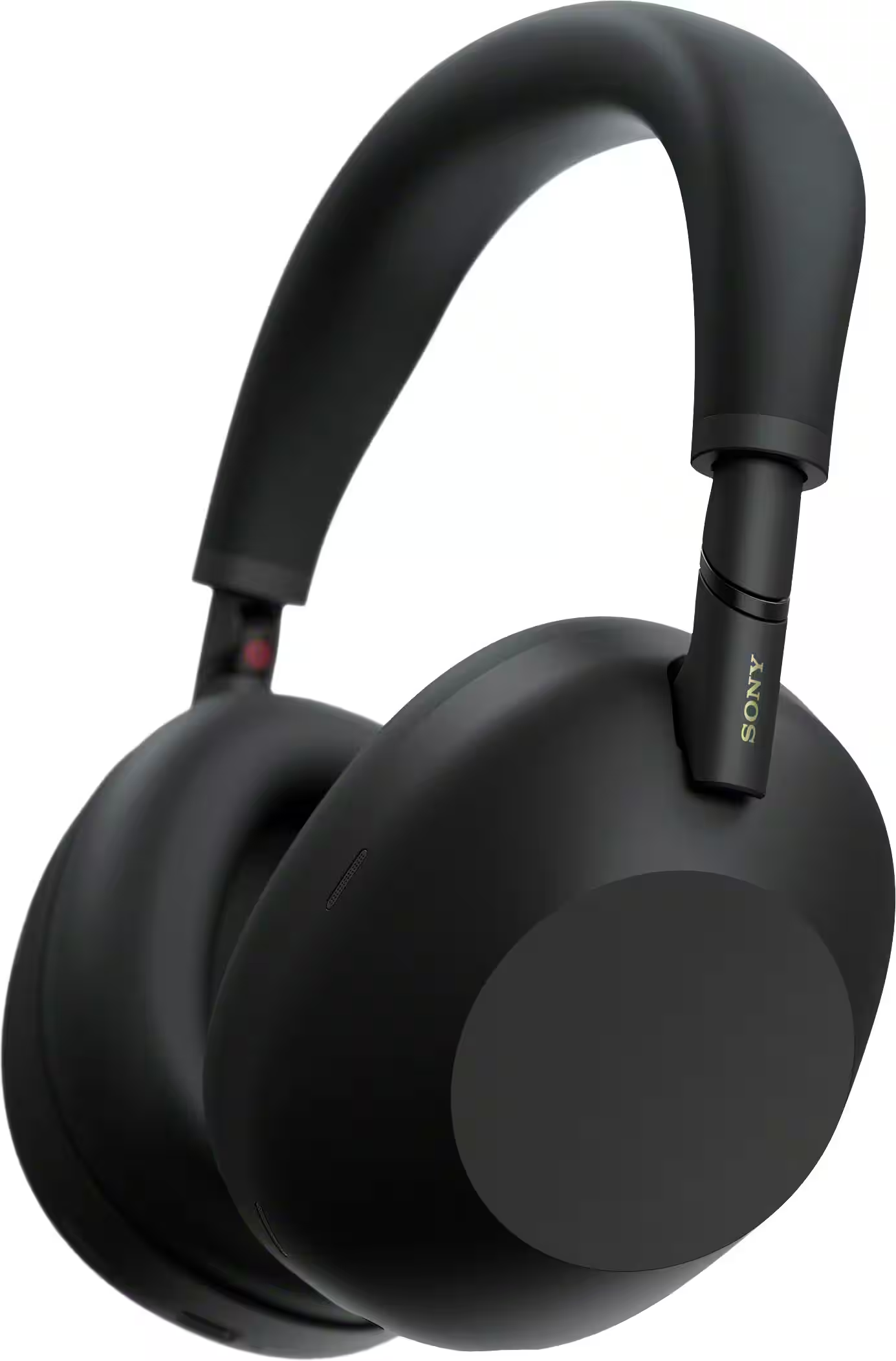
Picking up the XM6 for the first time, the weight is the thing that registers immediately. At 228g, it’s noticeably lighter than the XM5, and the difference is perceptible in a way that raw numbers sometimes aren’t. Sony has achieved this without the tradeoffs you might expect: the headband feels more substantial, not less, and the ear cups have a new recycled matte finish that sits somewhere between premium plastic and aluminum in terms of perceived quality. It reads expensive without being ostentatious about it.
The overall profile is slimmer than its predecessor. Sony has tightened the geometry around the hinge points and narrowed the ear cup depth slightly without compromising the seal. The cushions use a revised memory foam compound that remains comfortable after three-plus hours of wear — the XM5 was already good here, but the XM6 genuinely reduces the pressure-point fatigue that accumulates on longer sessions. The headband padding has been widened at the crown, which distributes load across a broader area of the skull.
The control surface on the right ear cup retains the same capacitive touch panel as the XM5, which is both a relief and a minor disappointment. Relief because the XM5 controls worked well once learned; disappointment because they remain over-sensitive to incidental contact when adjusting fit. The physical button cluster on the left cup — power, ANC toggle, and custom — continues to provide reliable tactile feedback. One unambiguous win: the 3.5mm socket has been joined by a USB-C audio input, so you can go wired without a headphone adapter on modern laptops and tablets.
Performance
Sony’s new QN3 processor is the headline hardware change, and it earns the attention. The XM5 used the V1 chip, which was already class-leading; the QN3 processes ambient audio through the same eight-microphone array but at a higher sample rate and with lower algorithmic latency. The practical result, tested across an overnight transatlantic flight, a week of open-plan office work, and a 90-minute subway commute, is ANC that feels qualitatively different from anything we’ve reviewed before. Low-frequency drone — engines, HVAC, road noise — is reduced to something approaching silence rather than dampened presence. The XM5 did this well. The XM6 does it better in a way you notice within the first minute.
The new 40mm carbon fiber drivers deserve equal credit. Carbon fiber diaphragms are lighter and stiffer than conventional mylar or polymer materials, which means they can move faster and stop faster — translating to tighter transients and more accurate reproduction of complex passages. In practice, the XM6 sounds more detailed than the XM5 without being clinical. The low end is full without being bloated. The midrange, where vocals and most acoustic instruments live, is rendered with unusual clarity for a consumer headphone at this price. There is a mild warmth to the tuning that flatters streaming-compressed audio without masking the resolution available in high-bitrate or lossless sources via LDAC or the new LC3plus codec.
Call quality has been a persistent weak point for over-ear headphones, including the XM5. The XM6 addresses this directly with a bone conduction sensor mounted in the left ear cup that reads vocal vibrations directly from your skull. The effect on voice pick-up in noisy environments is dramatic — callers on the other end consistently reported that they couldn’t tell we were in a busy coffee shop, something that was not true with the XM5 in the same test. For remote workers, this alone may justify the upgrade.
Spatial Audio & Smart Features
Head-tracking spatial audio has been available on Apple AirPods for years, and Sony has experimented with similar features in the past with mixed results. The XM6 implementation is genuinely different. Rather than simply pinning audio to a fixed external point, the XM6 uses a combination of accelerometer data, gyroscope readings, and scene-analysis processing to place sound sources in a coherent three-dimensional field that moves appropriately with your head. Watching a film on a tablet, turning to look at something beside you, and having the dialogue remain anchored to the screen rather than rotating with your head sounds like a minor detail — until you’ve used it. Then the absence of it in other headphones feels like an obvious regression.
Adaptive Sound Control 2.0 is a refinement of the XM5’s learning feature that adjusts ANC and ambient sound levels based on your activity and location. The new version adds context awareness beyond the original’s blunt motion detection: it can differentiate between sitting at a desk, walking, and riding transit, and it now incorporates time-of-day patterns from its usage history. After about a week it had learned that mornings mean maximum ANC and that walking to meetings means a moderate ambient transparency level. The adjustments feel intuitive rather than intrusive. The companion app lets you review and override these settings, which is the right call — automatic behaviour that you can’t audit is more unsettling than useful.
The three-device multipoint connection is a tangible improvement over the XM5’s two-device limit. For someone who works across a laptop, a phone, and a tablet — a configuration that is no longer unusual — not having to manually switch connections during the day removes a small but persistent friction. Latency across all three connections remained low in testing, with no perceptible lag on video calls or streaming media. One caveat: spatial audio disables when multipoint is active across more than two devices simultaneously, which is a reasonable engineering trade-off but worth knowing before you commit.
Value for Money
At $399, the WH-1000XM6 is $50 more expensive than the XM5 at launch and $100 more than capable mid-tier alternatives. That gap deserves scrutiny rather than hand-waving. The Bose QuietComfort Ultra headphones remain a legitimate alternative at a similar price, particularly if you prioritize comfort over absolute noise cancellation depth. The Apple AirPods Max are competitive in the Apple ecosystem for spatial audio specifically, though they lag on raw ANC performance and carry an even higher price. The Sony WH-1000XM4 can be found at steep discounts now, and it is still a very good headphone for the money.
The honest case for the XM6 is this: if you wear headphones for three or more hours a day and you care about the quality of that experience, the improvements are real and they accumulate. Better ANC means less mental effort spent filtering out your environment. Lighter weight means less physical fatigue by mid-afternoon. Bone conduction call quality means fewer repeated sentences on video calls. Spatial audio means more convincing media consumption. None of these are marketing abstractions — they are daily quality-of-life improvements that you stop noticing only because they become the new baseline.
For the casual listener who uses headphones an hour a day on public transit, the XM5 — or the XM4 at its current street price — is the more rational choice. But for anyone who lives in headphones, the XM6’s premium reflects genuine progress in the things that make all-day wear sustainable rather than merely tolerable.
Final Verdict
The Sony WH-1000XM6 is the best noise-cancelling headphone available in 2026, and the gap between it and the rest of the field is wider than it was when the XM5 held that position. The QN3 processor delivers ANC that has to be experienced to be believed; the 40mm carbon fiber drivers produce sound quality that embarrasses the asking price; and the bone conduction microphone turns voice calls from a weak point into a genuine strength. Spatial audio with head tracking works as advertised, which is more than can be said for most implementations of that feature in any product category.
The $399 price is a real number, and the absence of an IP rating means these are not workout headphones. If either of those facts rules it out for you, the XM5 remains excellent and is now available for significantly less. But if you are looking for the single best pair of headphones for working, travelling, and living in — regardless of what the competition offers — the XM6 is the answer with no meaningful qualifications attached.